Building a New House: the Bricks & Mortar of Culture Change
Minneapolis
March 3rd, 2026
My neighbor texts to ask if he can pick up the laundry at 8am. This afternoon, he’s helping a family self-deport back to the country they fled; they have an active asylum case. They’ve studied and planned, but there is some chance it won’t work: There is some chance they will be detained, and there’s a chance that the family will be separated, the mother held in detention or flown to Texas, and the three children, who my neighbor has completed DOPA forms for, could be sent home with him. Last night, he dropped off bedding because his laundry machines were full, so I washed the blankets. I tell him, yes, the laundry is done, I’ll drop it off on his back porch by 8:00.
I hustle to eat breakfast, get dressed, and dash downtown for the city council hearing on extending the eviction moratorium from 30 days to 60 days. By the time I arrive, I’m number 70 in the public comment order. I make it long enough to hear two friends testify: They are both organizing rent funds that have raised hundreds of thousands, and over a million dollars respectively. The rent is due, and there are still thousands of requests for rental assistance from each of these, and many more similar, funds across the city. I have to leave long before my number is called. I submit the remarks I prepared on the public comment form online.
I have to leave by noon because it’s time for grocery delivery. My neighbor, who lives on the next block south, picks me up and we go to the church one neighborhood over to pick up groceries for eight households. These folks live a mile north, and our blocks have formed a support pod.
In the summer, my wife and I, with friends living one block south of us, hosted a three-block block party, for everyone living between 35th and 38th streets, our blocks from the park to the school. While eating deviled eggs and playing “Get to know you” bingo, we tried to sound really relaxed and casual when people asked about the inspiration for this get-together. “Oh, you know, times are tough, Trump’s re-election, yikes!…. We just thought it would be nice to be more connected to our neighbors.”
These blocks south of the park have a few households of vulnerable folks, surrounded by many houses whose residents can more safely leave the house and provide support. Two blocks north of the park, the ratio is the opposite. A friend is organizing pods; connecting blocks like mine to form support pods for this block, where a single person has, for months, been solo-supporting a dozen or so families with groceries, rides, getting connected to rent funds and more. This is all taking place on a block that ICE and CBP was frequently terrorizing. Since I don’t speak Spanish, I use Google Translate to text everyone “Hi, my name is Jessica. I will be dropping off groceries by 1pm!”. I made the mistake of not sorting the list I was sent by address and it is unnecessarily difficult when we do drops. These are rookie moves and we are late. My neighbor told me she couldn’t speak Spanish either, but luckily she was under-selling herself and could roughly confirm with people who answered the door that we were getting the groceries to the right places.
These are our days. This is life in Minneapolis during the first week in March, 2026. This is regular now; I am not doing anything special or different from my neighbors. For some people, this has been their life for years, being involved with neighbors in day-to-day tasks, big and small. I am one of the many folks whose life has been transformed. There is much I was doing in December 2025 and a lot I thought I’d be doing in 2026 that I have put down. Instead, there are so many more neighbors who I know and who I know more about. I recognize familiar voices on the rapid response calls, I know which of my neighbors can lead songs, I know who’s unemployed and looking for work, who’s baking more, who sneaks a cigarette in stressful times after their kids go to bed, who’s a notary, who has a new kitten. I know the overnight shift at Target ends at 5:30am. There are apartment buildings I used to walk by as background scenery, where I now visit neighbors.
It is now March, and there are fewer ICE agents in the streets. There are now, instead, bounty hunters hired by ICE, terrifyingly even less trained than ICE, something we did not dream possible. Some people are starting to slowly, dangerously, return to work, if they can find it. But, fewer ICE agents still means many hundreds of ICE agents, and the need for rides so people can get out safely is as great or higher than before. Back rent is piling up and coming due. Health concerns that went untreated for months are worsening. The national media has moved on, as we all expected, but the crisis remains and, in many ways, grows, while changing shape. It is now March, and we have to figure out what now, and what next.
We will not, we say, go back. There is a lot to strategize: Do we reconfigure some of the rapid response networks now that the threat from ICE is taking place in different neighborhoods, times and shapes? How do we expand what we do to include eviction defense, as rent comes due for hundreds of thousands of neighbors who have been unable to leave their homes for months, and elected officials like Mayor Frey and Governor Walz refuse to take, and actively block, action to keep people housed? How will the truly uncountable networks of grocery, rent, laundry, childcare, medical care, school patrols, etc., sustain people beyond the initial swell of crisis response?
Whatever political and organizational strategy we create going forward, it must be grounded in, infused with, and committed to the most basic, fundamental, foundational, and revolutionary transformation that we created in the Twin Cities in 2026. We transformed ourselves, and we transformed how we relate to each other.
Winter 2026 in Minneapolis has been devastating and heartbreaking; it has also been profoundly transformative, empowering, and uplifting, to see how we can protect and care for one another. We know that, be it from the violence of this authoritarian regime, the breakdowns of neoliberal capitalism meeting fewer and fewer peoples’ needs, or the many, increasing in frequency and intensity, crisis of climate chaos, the conditions of our lives will continue to deteriorate. What this time has shown us is that we are, more and more of us, capable of taking incredibly heroic actions. Just as importantly, we are able to transform our daily lives in ways that, at first, seem mundane (car rides and laundry) but are, in fact, the building blocks of a profound shift in relationships that mean an utter reimagining of society.
If we want this different way of life to continue and grow, which everyone I talk to does, it will be necessary to be intentional about naming what we’re doing, understanding it, and cultivating it. This way of life is, in fact, counter-cultural to the dominant culture of our time and place. While beautiful, this way of relating to each other is also currently inconvenient, hard, and deeply disincentivized. If we want this way of relating to continue, we must be intentional about it. We must also intertwine this new culture of societal organization, with a new culture of customs, art, and creativity that is the necessary connective tissue of our lives.
It is almost spring. I am asking, in the season to come, how will we live with each other? Which is to say, who will we be?
Culture: Bricks and Mortar
‘Culture’ is one of those abstract words that we often use without defining. I looked it up, and had the gratifying experience of the dictionary definition encapsulating all of what I wanted it to mean. From The Oxford English Dictionary: “the customs and beliefs, art, way of life and social organization of a particular country or group.” The etymology of the word ‘culture,’ is mid-15 century, "the tilling of land, act of preparing the earth for crops;" from Latin cultura, "a cultivating, agriculture;" figuratively, "care, culture, an honoring;" from the past-participle stem of ‘colere,’ to “tend, guard; to till, cultivate." It makes great sense to me that this word, for how we relate to each other, and the art and rituals we create about it, relates to preparing the land for intentional planting and growing, for the ways we feed and nurture ourselves. These things, the word reminds us, are inextricably linked.
This resonates deeply, living in Minneapolis in 2026, for there to be a single word to describe both beliefs and social organization (what we think and feel, and how we treat each other), and art, ritual, knowledge, creative flourishing; one word that describes how we are to survive. Living in Minneapolis during Operation Metro Surge has been a crash course in new culture: It is a reorganization of societal relationships, and the beginnings of flourishing of customs, art, and ways of life that reflect our new way of relating.
I understand “culture” as the house we collectively build: The bricks as the material ways we relate to each other, and the mortar as the art, music, language, humor, ritual, memorials, and food that hold together our relationships. We absolutely need both in order to build a house; one without the other is a bucket of gloop, or a pile of bricks that does not hold together.
Culture is, more often than not, created and transmitted unlabeled as such; it can be thought of as the air we breathe, the water in which we swim. Culture will change whether we work for culture change or not. It will shift over time no matter what we do, changed by infinite large and small choices that all of us make every day. But culture can, and does, change, creating profound impacts on our lives. Culture change is often undervalued as an aspect of political organizing and transforming the world, for many reasons. Culture change seems immaterial, compared to things like laws, wages, and policies. Political change seems like it requires elected officials to make it real. Cultural change is slow, soft, and directionless.
But culture is profoundly influential: Who we relate to, how we relate to each other, how we organize those relationships, and how we communicate our expectations about relationships underlays everything else about how we live. For example, in a culture where the expectation is for adults to move away from their family of origin and find a romantic partner with whom to make a home and have kids, achieving that goal shapes every life choice. In a culture where multigenerational households are the norm, living with adult friends is celebrated, living in multifamily shared housing is physically possible, our daily lived experiences and life choices have the potential to be extremely different.
In Minnesota this year, a culture of protecting only our own, isolation, separation, and distancing from people with different lived experiences would have resulted in very different responses to Operation Metro Surge. Instead, people lived out a different set of societal relations, one that valued caring for and protecting those who we live among, across lines of difference. We have an important and rare opportunity right now, as people who’ve been part of a cultural change, to name it and cultivate it and celebrate it, and continue to push it in the ways we want it to go.
As an organizer, I have for years been talking about culture, sometimes naming it and sometimes not. I have named solidarity with all oppressed peoples, interdependence and interconnection, “all of us or none of us”. Though I have strived for my organizing to embody these values, though I have articulated this as the vision of the world in which I anchored work for change, the truth is that I have not, (and I think very few of us have) managed to live it in my own life very often. My day to day life has been organized primarily around friends and family, that’s who I would pick up if their car broke down. But, in the past few months, based on the necessity of crisis and urgency of conditions, my daily life has changed, my way of relating to my neighbors has changed, my circle of concern has changed.
Fifteen years ago, I went to rabbinical school in large part because I believed in the power of culture to transform and to be transformative. I saw the ways in which Jewish culture, calcified around a narrative of victimization, had created, fed, and is used to justify social relations and political realities that keep us isolated from other peoples’ struggles for liberation and safety. I was motivated not only by wanting to push against the dominant isolationist Jewish culture of our time, but also by a desire to study and pull from millennia of Jewish tradition that practiced and highly valued care and interconnection. Traditionally, as in many cultures, the practices of closely knit neighborhoods where people looked out for and resourced each other have been practiced exclusively or primarily with other members of the shared community. But they in no way have to be. I saw the values and the customs of Jewishness as brimming with wisdom to guide the cultural transformations we need now. I believed that, as a rabbi, I could be part of Jewish cultural change, with both relationships and creative expression nurturing each other. I wanted to be part of organizing that was infused with art and ritual, and create art and ritual that expressed our political commitments.
I have dedicated my life to this premise. And, I’ll admit, I have had recurring doubts about the efficacy of it. This uncertainty usually surfaces just before the Jewish New Year, when my life becomes completely overwhelmed by preparing for the packed days of ritual and ceremony. When I feel at a greater distance from what, in those moments, I’m sure is the “real work” of political organizing, I can become flooded with misgivings.
In these last months in Minneapolis I have developed a renewed faith in the power of culture as the foundational building block, the guiding north star, and the vision of what we’re working toward. I have a clearer vision of what that looks like because, most importantly, I have a much more deeply embodied sense of what it feels like to live differently.
Bricks
In the dominant culture of the 21st century U.S., the bricks of our cultural house are generally shaped by the beliefs of capitalism, white supremacy, and colonialism that dictate relationships and societal organization. It is considered normal, the obvious way to live, that our circles of care and concern, who we shape our days around relating to, are nuclear family; friends of some shared experience (ie, from school or work) or group (sexuality, race, ethnicity); and, maybe, religious group. By “circle of care and concern”, I don’t mean who we abstractly wish well. I mean who we would actually pick up if their car broke down, who we would host in our house if they didn’t have somewhere else to go, who we would text on the way to the grocery store to see if they needed anything. In the dominant culture of the U.S., our circle of care and concern does not generally include people we live nearby if they don’t fall into those other relationships. Most of us have been living intensely isolated lives, all the while knowing that many of our neighbors are struggling immensely. Meanwhile, we ourselves are struggling, and feeling helpless and disconnected in what we are facing.
In the Twin Cities in 2026, our circles of care and concern shifted to include the people on our block and in our neighborhood. This way of living is the way most people survived for most of human history, caring and fighting for the people who they live closest to, and organizing society around geographic proximity. But it is, in the context of the U.S. in the 21st century, a profound cultural change.
While there were, and are, mutual aid organizations with names and sign-up sheets and drop off locations and shifts doing essential work, the profound transformation happened because those we were delivering groceries and giving rides to were, for the most part, nearby neighbors whose homes we knew and visited, families who we dropped off rent money for and gave their kids a ride to school, teams of neighbors on our blocks supporting people who we live among. Friends of neighbors and neighbors of friends, created an increasingly threaded web of connections, across the lines of citizenship status, race, language, class, sexuality and religion that ordinarily separate us, and thus created the beginnings of a new culture.
This is not a brand new idea; in resistance movements, we are frequently naming white supremacy culture, the impacts of capitalism and settler colonialism on relationships and structures of society. What is often missing is any clarity on what type of cultures we want to move towards or with which we want to replace our current cultural scripts. I think this is part of why there can be such mushiness and confusion about critiques of white supremacy culture, where it can become a replacement for any behavior we don’t like at any given time. To create culture shift, and to have it really stick, really become a way of life, we need more than a critique of the current ways of relating, we need a vision for and practice at the culture we’re aiming for.
We do not have to start from scratch. There are different cultures of relating better suited to surviving and thriving than the isolation of white supremacy and competition and hoarding of capitalism, that are happening all around us, all the time. And, we all come from lineages of cultures with different ways of relating, and with art and stories about it. As Susan Raffo articulated on Movement Memos:
This is about actually remembering what our ancestors have always known and what at its core is the only way that we actually survive. We are all always interconnected. That is the core truth... It is always here, whether we are feeling it, witnessing it, nourishing it, remembering it, claiming it, deepening it, whether we do that or not, it is just always here.
We see that this interconnection happens, in some form or another, in most of what we now call ‘subcultures,’ that is, racialized communities, religious minorities, people marginalized by sexuality and gender, disability, and poverty. In order to live in times of fascism and climate catastrophe, whose impacts we are and will be experiencing on the very local level, across identities and subculture, is to make the cultures of interconnection and circles of care regional, local, hyperlocal, and relational, on the person-to-person level.
Mortar
As we remember this very old truth, that we are all interconnected, and live more fully into that truth, we must attend to all aspects of culture. Alongside of and interwoven with this different way of relating, the bricks of a new, old, culture being formed and reformed in Minneapolis, there has been the mortar of newly different culture, the art and ritual and creative expression of our new ways of relating: wearing a whistle, songs that people know from singing in the streets at protests and vigils, new sacred sites of memorializing those who've been killed by ICE, art and images all around us. For rapid response there is a whole language, humor, symbols, and way of communicating. Block clubs and block parties, grocery deliveries and school patrol are all ways of being together that have their own languages and are starting to have their own cultures. Seeing the sprouts of this new creative culture being formed from our new relational culture, I understand this time through my rabbinic work in creating liberatory Jewish cultures.
From this vantage point, I can see one of the reasons for why this ICE response happened in Minneapolis: This is a city that has cultures forged from strong connection to the place. Most people don’t live somewhere that gets to -20 for at least a few days most winters without either being from here and rooted here, or really wanting to be here. It is a place where the Dakota origin story, history, names and relationships to the land, disrupted and damaged by the settler state, are still extremely present and felt, at Bdote, at Bde Maka Ska, at Little Earth, and in the American Indian Movement vehicle that is part of ICE watch patrol in Phillips.
It is also a place where even white people take part in shared culture. I’m thinking of, in my neighborhood, Powderhorn, of Barebones in the fall, Art Sled Rally and Ice Shanties in the winter, and May Day in the spring. I’m thinking of George Floyd Square. These are festivals and a physical location that defy the logic of separation and embody a connection to the earth, to this place, to the specific conditions and history of this place. Paying rent or a mortgage alone won’t do that; organizing travel through your neighborhood around and through a multi- block memorial, and organizing your yearly calendar around community-wide celebrations, are much more likely to connect us to a place. Shared connection to place is one experience that fosters connection to the other people who live there. This connection makes it much more likely, I believe, for people to step out of their houses and risk their lives and livelihoods for their neighbors. And, even that is not on its own enough.
Minnesota remains a deeply segregated state with one of the largest racialized wealth gaps in the country. I am not suggesting that parades will do anything to address the urgent disparities and many crises people here are facing. What I’m saying is that one central, and often ignored, aspect of the political transformation we need is culture shift, in beliefs and social organization. We need to ask who do we care about, who do we take risks for? And, that relational culture shift requires the other part of what is culture: shared art and ways of life that reflect our relationships and values, where we can grieve and celebrate, mark the seasons and honor our shared home. The culture we are creating must be capacious enough to honor the many existing cultures we are each bringing, and we must be unafraid to create new cultures, and to share them.
Dreaming Forward
A few times in the last months I have been dismayed to hear organizers I respect, reflecting on this moment in the Twin Cities disparage the culture change we’ve been living into. After talking appreciatively about the powerful care work everyone’s involved in, they say “but we’re not going to ‘mutual aid’ our way out of this,” as a way to pivot to a call for purportedly more systemic organizing strategies and tactics. Transparently, responding to that phrase “We’re not going to ‘mutual aid’ our way out of this,” was one of my motivations for writing this piece.
To me this sounds frighteningly irrational, both about the moment we are in, and how meaningful political organizing and transformational change happen. First of all, we are in a context of climate chaos, entrenched and growing poverty, fascism, as people’s daily lives are increasingly crushed by the present and coming impacts of the systems we’re living in. Having neighbors with whom we share food and water, who we will put ourselves between each other and harm’s way, this is truly what will be life saving for many of us, in ways we can’t even fully imagine yet.
Second, whatever liberatory transformation you are seeking and whatever organizing strategy and tactics you want to use to get there, it will be more possible, durable, widespread, and lasting if it grows from and feeds into a culture where people take care of each other across lines of difference, and are organized locally to know about each others’ lives and needs. I want, as always, to be involved in rigorous discussions of political strategy about how we could possibly make a dent in the war machine and the profound injustice of criminalizing migration, especially during a time of rising and present authoritarianism. But how many more people will show up for that organizing if increasing numbers of us are in caring relationships with our neighbors across lines of difference? How much stronger could our organizing be if we truly lived in a culture of solidarity in our neighborhoods, towns and cities? Before, underneath, and braided throughout any organizing strategy and tactics is how we treat people who we are not related to or friends with, who we now see in our circle of concern, who we now see as our people. Whatever organizing strategy we’re invested in, we can build from the culture of interconnection that has been created, rather than disparage and minimize it.
Third, and most importantly, the culture of mutual aid, interconnection, giving and receiving care with our neighbors: this is not just means to an end, these are the ends. This is it, y’all. The world we’re working for is one in which we are all taking care of each other. As mutual aid grows, the world we’re working for blooms.
Before capitalism, life was for most people, most of the time, filled with the activities of meeting the daily needs of ourselves and each other. We grew our own food, we built our own shelters, we raised our children, we cared for our sick and our elderly. We taught each other how to do the things we needed to learn to do. We also told stories, sang songs, danced, painted, we entertained each other. Capitalism has made it so that some people don’t have to do most of those things, and instead can pay other people to do them. To extremely over simplify things, I’ll assert: that’s not sustainable. In the world we’re working towards, there are no police in part because all people can take part in interrupting violence and repairing harm. If we do manage to rebuild a sustainable food system, it will be because many, many more of us are involved in growing and distributing food where we live. As the health care system crumbles, more of us will have to learn how to provide basic medical care for each other.
I am not against specialization and training, and I don’t feel particularly nostalgic about the past or romantic about the future. I just don’t see another way. We will mutual aid our way out of this, because what we currently call mutual aid is not just the way out of this, it is where we are headed.
Building a New House
These days, I can see and feel the gravitational pull towards going back to the dominant culture of isolation, and I am so moved to see so many of us continue to live in a culture of interconnectedness. Some of this looks like conversations on how to grow eviction defense out of ICE watch networks; how to transition school patrols to be more sustainable, long term organization; how to provide not only one-off care spaces, but also to create ongoing healing and tending, and to resource people providing that care. It is all this and more.
A large part of what also needs to happen in order for the culture change we’ve lived into to be sustainable is that our interconnectedness must grow to become more multidirectional, reciprocal, and integrated into our lives. For the last several months, those of us not targeted by ICE have been supporting vulnerable neighbors and, appropriately, not expecting to receive care or support. If we are to truly transform from a culture of isolation to a culture of connected care, all of us must see ourselves as part of circles of that care, giving and receiving, in different ways at different times, and getting some of our needs for social connection met through our neighbor relationships. We already see this happening: in the Somali grandmothers, who are patrolling their own neighborhoods and handing out tea and sambusas at protests and ICE watch, to the Morning Banger dance parties at Latino businesses. The whole neighborhood, those of us in hiding from ICE and those of us doing ICE watch, create safety in numbers at a daytime party, supporting local businesses and receiving deeply needed joy and release. We felt this on February 7th, when we gathered for Wokiksuye – In Remembrance & Witness, an Indigenous held, public memorial for Renee Good.
I’m heartened to see this happening more and more, woven into the fabric of our lives. A few days ago, on the rapid response ICE watch group call, someone asked if anyone driving around could drop them at the airport in an hour; someone came off mute and said, “Yes, actually, that’s when I’ll need to be finishing up this shift and that’s on my way home, I’ll DM you.” On my block text thread, someone asked for help with a flat tire, and a few hours later I saw that person respond, thanking two other neighbors for showing up. It snowed yesterday, and on every thread I’m on people were sharing snow blowers and digging each others’ cars out. These are small, small moments. And, to me, they signaled an incredibly hopeful possibility of the culture we’ve been creating growing and sustaining.
That is the work of adding more bricks to this house; we also need to tend to the mortar. After a meeting of block captains a few weeks ago, I asked one of my neighbors if she would co-host a “first day of spring” festival with me for our neighborhoods of Powderhorn and Phillips. We are both people who lead seasonal rituals for our subculture communities, she in her in Celtic lineage, I in my Jewish community. We are now, joyfully and awkwardly, trying to figure out how to create an afternoon that will logistically work and be culturally meaningful to the neighborhood and all of our different communities. This is out of my comfort zone. I feel deeply aware of all of the possible mistakes and missteps. I feel nervous inviting people to it. I feel the awkwardness of this endeavor. And, I want to have something to invite the neighbors I’ve been driving to work and dropping off rent money for to come to where we sit and eat together. I worry about their safety and wellbeing, and so I want to know them. And, I can feel a shift in myself where I am starting to allow myself to want them to know me.
Listening to the old, wise voices we can all hear if we are willing to listen to them calling us towards each other, this is how we will learn to live differently, this is how we will build a new house together.
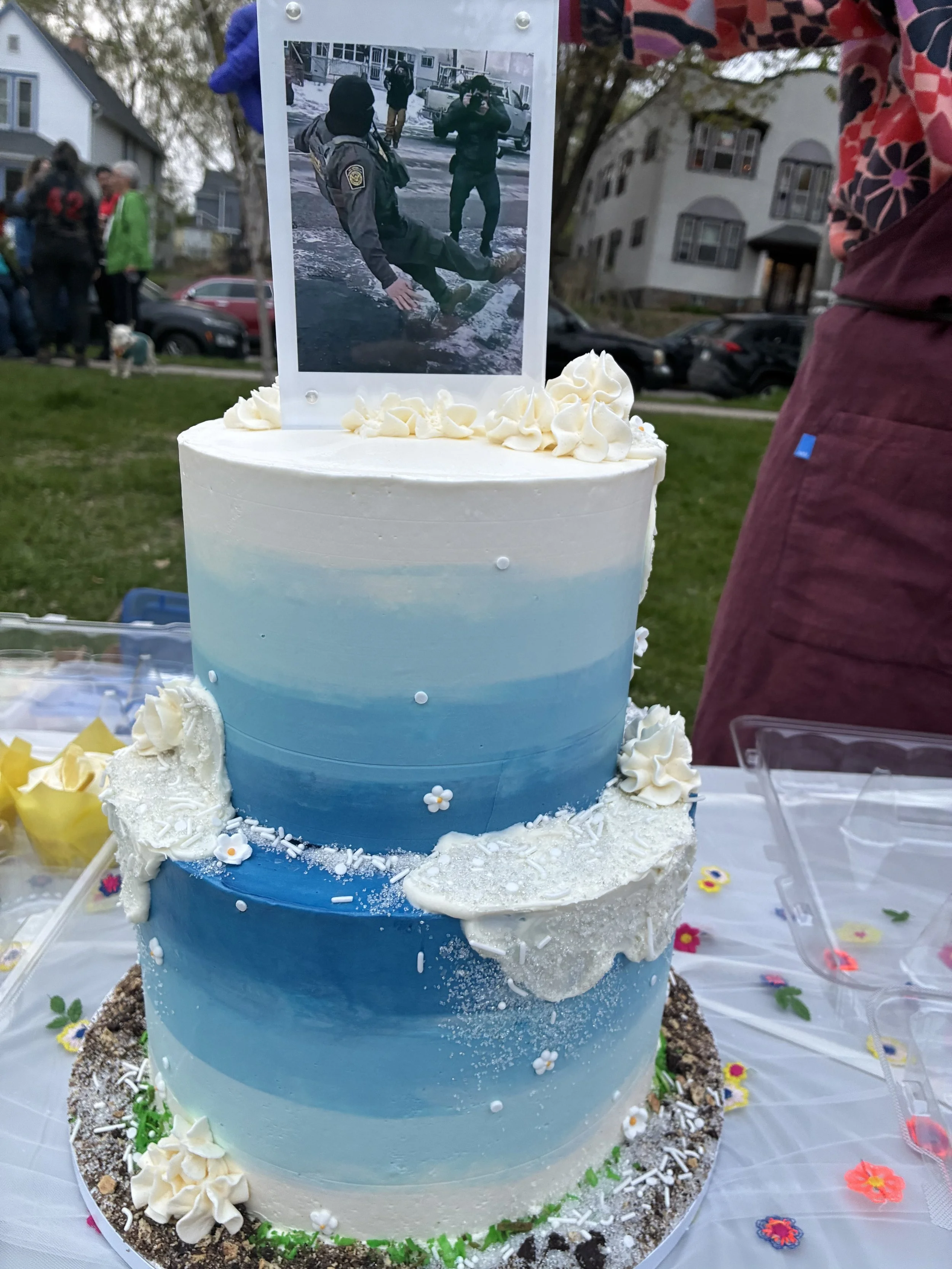
Image of a 2 layer cake with layers of blue frosting and melting ice, topped with an iconic photo of an ICE agent slipping on ice.